NACS vs CCS: The Difference, and Why V2 Superchargers Are Still Closed
Published
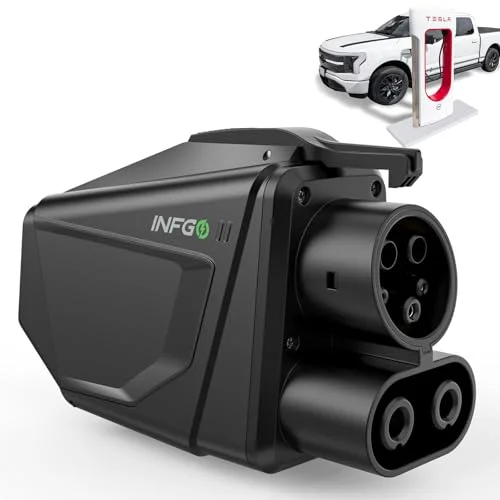
CCS1 is a J1772 AC head with two DC pins added below. NACS, standardised as SAE J3400, does both jobs on the same two pins. An adapter between them works on V3 and V4 Superchargers, never on V1 or V2: the barrier is protocol, not shape.
The two connectors
| CCS1 | NACS / SAE J3400 | |
|---|---|---|
| Housing | Two-part: J1772 head plus a DC block below | One connector |
| Pins | 5 AC pins plus 2 DC pins, 7 total | 5 |
| AC charging | Through the J1772 half | Through the same two power pins |
| DC fast charging | Through the two added DC pins | Through the same two power pins |
| DC rating | Up to 500 A / 1000 V | 500 A / 1000 V |
| Communication | Power-line communication over the control pilot | Power-line communication over the control pilot |
| Standardised as | SAE J1772 combo, IEC 62196-3 Configuration FF | SAE J3400, Recommended Practice since September 2024 |
| Fitted to | Most non-Tesla EVs sold in North America through model year 2024 | Every Tesla, plus factory ports on most brands from model year 2025 |
The row that explains everything else is the communication row. Both connectors use the same power-line signalling to negotiate a charge, which is precisely why an adapter between them can work at all. The pins are in different places; the conversation is the same language.
Why V1 and V2 Superchargers stay closed
Tesla’s first two Supercharger generations were built before that shared language existed, and they speak Tesla’s own protocol over a different physical layer. A car that only knows the standards-based conversation cannot negotiate a session with them. There is nothing to adapt: the connector already fits, mechanically, and the charge still never starts.
V3 changed that. From V3 onward the stations support the standard protocol, which is what made opening the network to other brands possible in the first place, whether through Tesla’s own built-in Magic Dock cable or through an adapter the driver carries.
| Supercharger generation | Peak power | Works with a CCS1 car and adapter |
|---|---|---|
| V1, from 2012 | 90 to 120 kW | No |
| V2, from 2016 | 145 kW, raised to 150 kW in 2019 | No |
| V3, from 2019 | 250 kW | Yes |
| V4, from 2023 | Up to 500 kW on a V4 cabinet | Yes |
One wrinkle on that last row: many V4 posts are installed on V3 cabinets and still deliver 250 kW. The 500 kW figure belongs to the cabinet, not the post, so a V4-looking stall is not automatically a 500 kW stall.
INFGO states its adapter reaches more than 15,000 V3 and V4 Supercharger ports. That number moves as the network grows, and which specific sites are open to non-Tesla cars is set by Tesla, not by the adapter, so check the station in the Tesla app, PlugShare or Google Maps before you plan a stop around it.
Three ceilings, and the lowest one wins
Three ceilings apply at once, and the lowest wins.
| The limit | Value on INFGO’s adapter |
|---|---|
| The adapter’s rating | 500 A / 1000 V, stated maximum 250 kW |
| The station’s peak | 250 kW on a V3, up to 500 kW on a V4 cabinet |
| The car’s accepted rate | Whatever the vehicle allows, often 100 to 250 kW |
On a V3 the car is usually the binding constraint, which is why two vehicles at adjacent stalls can charge at half each other’s rate through identical hardware. On a full-power V4 cabinet the adapter’s own 250 kW ceiling becomes the limit instead — worth knowing, though few cars on the road today can accept more than that anyway. The 500 A and 1000 V rating is not the same number as the 250 kW: it is the electrical headroom that keeps the adapter from being the weak link on an 800 V vehicle, and 250 kW is what INFGO states it will carry.
Checking the manufacturer’s own claim
INFGO states the adapter delivers up to 150 miles of range in 15 minutes. That is worth checking rather than repeating, because it is checkable.
Fifteen minutes at a V3 station’s 250 kW peak is 62.5 kWh. At 2.3 to 3.5 miles per kilowatt-hour — the band that reproduces INFGO’s own published figures elsewhere in its range — that is 144 to 219 miles. So 150 miles sits at the bottom of the band and requires close to peak power for the whole quarter hour.
Which is to say the claim is arithmetically sound and practically optimistic. Real sessions taper as the battery fills, and the taper is steep above roughly 80 percent, so the honest version is that 150 miles in 15 minutes is achievable on a car with a high acceptance rate arriving at a low state of charge, and not a figure to plan a road trip around.
| Battery | 10 to 80 percent | At 150 kW average | At 100 kW average |
|---|---|---|---|
| 75 kWh | 52 kWh | about 21 minutes | about 32 minutes |
| 100 kWh | 70 kWh | about 28 minutes | about 42 minutes |
Before you rely on it
- Confirm the car can DC fast charge. Some plug-in hybrids and EVs built before about 2016 have no DC inlet at all, or have one that will not accept a Supercharger session.
- Confirm the site is open to your brand. The Tesla app labels sites; PlugShare and Google Maps carry the same information from drivers who have been there.
- Confirm the generation. A site with V2 stalls, or a mix, will fail on the V2 ones with no useful error.
- Check the direction of the adapter. This is the most common ordering mistake in the category. INFGO’s adapter takes the Supercharger’s NACS plug into a CCS1 car. The opposite product, a CCS1 station into a NACS car, is a different adapter entirely.
Where each one leaves you
If your car has a CCS1 inlet, a NACS-to-CCS adapter adds the largest fast-charging network in North America to the ones you already use, on V3 and V4 sites. It is a road-trip accessory and nothing more: at home the connector question is a different one, covered in J1772 vs NACS, where the two turn out to be equivalent because home charging never touches DC.
If your car has a factory NACS port, you need no adapter for Superchargers and the NACS Level 2 charger is the one that saves you handling an adapter in your own garage every night.
The transition is a decade-long overlap, not a switch. Most households will own one car of each kind at some point, which is the real argument for owning the adapter rather than replacing the hardware.
Frequently Asked Questions
What is the difference between NACS and CCS?
CCS1 is the North American fast-charging connector: a J1772 AC head with two DC pins added in a second housing below it. NACS, standardised as SAE J3400, does both jobs on the same two pins in one small connector. Both are rated to 1000 V and 500 A on the DC side, so the difference is packaging and protocol, not capability.
Can any EV charge at a Tesla Supercharger with an adapter?
Only at V3 and V4 stations, and only if the car supports DC fast charging in the first place. V1 and V2 Superchargers use Tesla's older communication protocol and cannot negotiate a charge with a standards-compliant car, so no adapter makes them work. Some plug-in hybrids and EVs built before about 2016 cannot DC fast charge at all.
Why does a NACS to CCS adapter not work on V2 Superchargers?
Because the limit is software, not shape. V3 and later Superchargers speak the same power-line communication protocol that CCS and J3400 use, which is what lets a non-Tesla car request a charge. V1 and V2 stations predate that and speak Tesla's proprietary protocol. An adapter can change the connector; it cannot change the conversation.
How fast can a CCS car charge at a Supercharger?
Up to the lowest of three ceilings: the station's, the adapter's and the car's. A V3 Supercharger peaks at 250 kW, which is also the rating of INFGO's adapter, so on a V3 the car's own limit usually decides. A car that accepts 150 kW gets 150 kW, whatever the station and the adapter could deliver.
Is the 500 A 1000 V rating on the adapter useful today?
It is headroom rather than a promise, and it is not the same number as the power rating. Five hundred amps at 1000 V is 500 kW of electrical capacity, while the maximum INFGO states the adapter will carry is 250 kW, which matches a V3 Supercharger. The high voltage and current rating matters because it covers 800 V vehicle architectures without the adapter becoming the weak link in the chain.
Do I still need a CCS adapter if my next car has a NACS port?
No. A factory NACS port plugs straight into a Supercharger. The adapter exists for the CCS1 cars already on the road, which is most non-Tesla EVs sold before model year 2025, and it stays useful for as long as one of those is in the household.
The adapter that opens V3 and V4 Superchargers
INFGO's NACS-to-CCS1 adapter is rated 500 A and 1000 V DC, carries up to 250 kW, and locks on both the NACS and the CCS end. IP65 housing in UL 94-V0 flame-retardant PA66.
See the NACS to CCS adapter